Key Takeaways
- The 996 work culture is currently resurfacing in the tech industry, demanding 70+ hours a week.
- Instead of reducing hours and creating balance, some companies use AI to push employees harder, framing extreme workloads as ambition or necessity.
- Some tech companies openly advertise 70+ hour weeks, offering high salaries, bonuses, perks, and career growth as incentives to normalise overwork.
- Myths about productivity and success drive this trend; longer hours are incorrectly equated with higher output, despite research showing productivity plateaus under extreme pressure.
- A cultural shift is needed: instead of glorifying overwork, true progress should focus on smarter work, more balanced lives, and sustainable innovation.
2025 is shaping up to be a year worth remembering. Unfortunately, not for a breakthrough, as you might expect, but for a paradox that should have stopped us in our tracks.
At the same time we celebrate AI as a tool for efficiency and greater freedom, an old and brutal work model once associated with exploitation is quietly resurfacing in places we never imagined it would. That model is the 996 work culture.
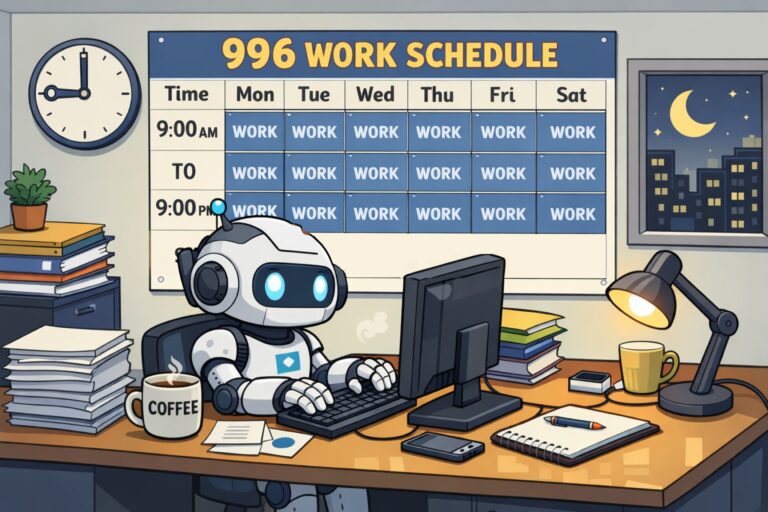
For anyone unfamiliar with the term, 996 means working from 9 in the morning to 9 at night, 6 days a week. That adds up to a 72-hour workweek. That’s not just demanding; it’s physically and mentally draining by design. Not to mention that this kind of schedule leaves very little room for anything resembling a life outside work.
Here’s a video that takes a deeper dive into the world of 996 work culture:
When Tech Advances, but Work Gets Harder
AI was meant to help us create better, more balanced lives. A world where machines take on tedious tasks so we can have more free time. That was the sales pitch. What nobody expected was some CEOs immediately thinking, “What if we replaced half the staff with AI and made the rest work twice as much?”
To add salt to the wound, Sergey Brin said earlier this year that 60 hours a week is the “sweet spot” for productivity. This is almost amusing in hindsight, because the 996 model blows right past 60 hours like it’s just a warm-up. If 60 hours is sweet, then 72 must be the chilli-infused version that only the toughest employees can handle.
But what makes the shift to the 996 working hour system truly shocking is where the warning came from. In 2021, China officially declared the 996 work culture illegal. This decision came from a country long criticised for extreme working hours. Although implementing the new laws has proven challenging, the message was clear enough: the 996 work model was deemed too harmful to justify. Since then, a growing number of Chinese companies have publicly moved away from the 996 workweek to avoid penalties and reputational damage.
When a work style is deemed too harsh for the country that popularised it, you might think other countries, especially the developed ones, would take the hint.
But that’s not what happened. Nearly two continents and an ocean away from China, Silicon Valley’s AI companies seem to have looked at that system, nodded thoughtfully, and said: “Thank you, we’ll take two!”
This has led to the 996 work culture being increasingly normalised, sadly not just in Silicon Valley but across many other tech circles, where the 70+ hour workweek is no longer shocking but framed as ambitious and even inspirational.
To motivate the adoption of the 996 workweek, industry leaders are talking about a race for AI dominance the West must win at all costs — even if winning means losing its soul. Meanwhile, the companies at the forefront of this trend are careful to wrap it all up in promises of high salaries, generous bonuses, free meals, and stock options, all tied up with a bright red bow of other feel-good rewards and future growth opportunities.
Even though they confidently push slogans like “work now, live later”, the cost is already visible. Burnout is rising, retention is slipping, and a growing disconnect between work and life is clashing head-on with the post-pandemic “YOLO” (You Only Live Once) mindset, shaped by the realisation that life is short.
The “996 Obsession” Is Spreading
The most concerning aspect right now is how openly some firms embrace the new trend. This isn’t an underground practice whispered about in private Slack channels, nor does it affect only the AI players in Silicon Valley. A growing number of tech companies across the US include it in their job postings, almost proudly, as if candidates will read “70+ hours a week” and say, “Fantastic! I’ve been dreaming of sacrificing my spine and social life”.
In that respect, here are a few examples that stand out:
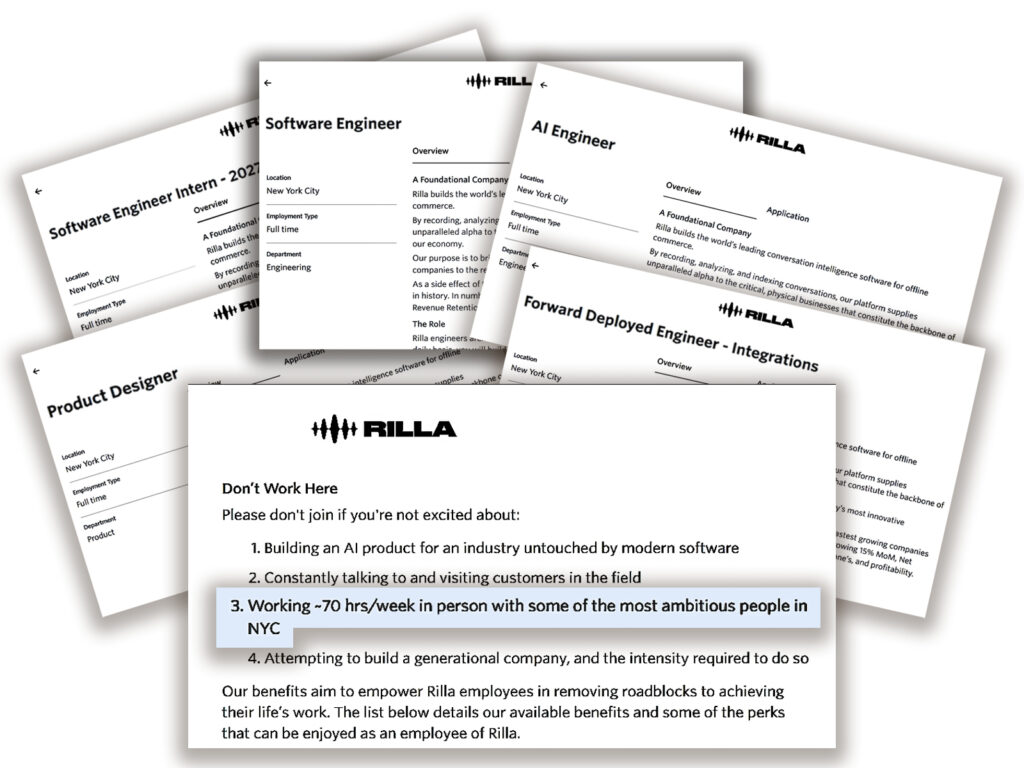
RILLA, a New York-based AI startup, openly lists roles requiring more than 70 hours a week. No softening language, no poetic phrasing like “hero hours” or “founder energy”. Just raw numbers.
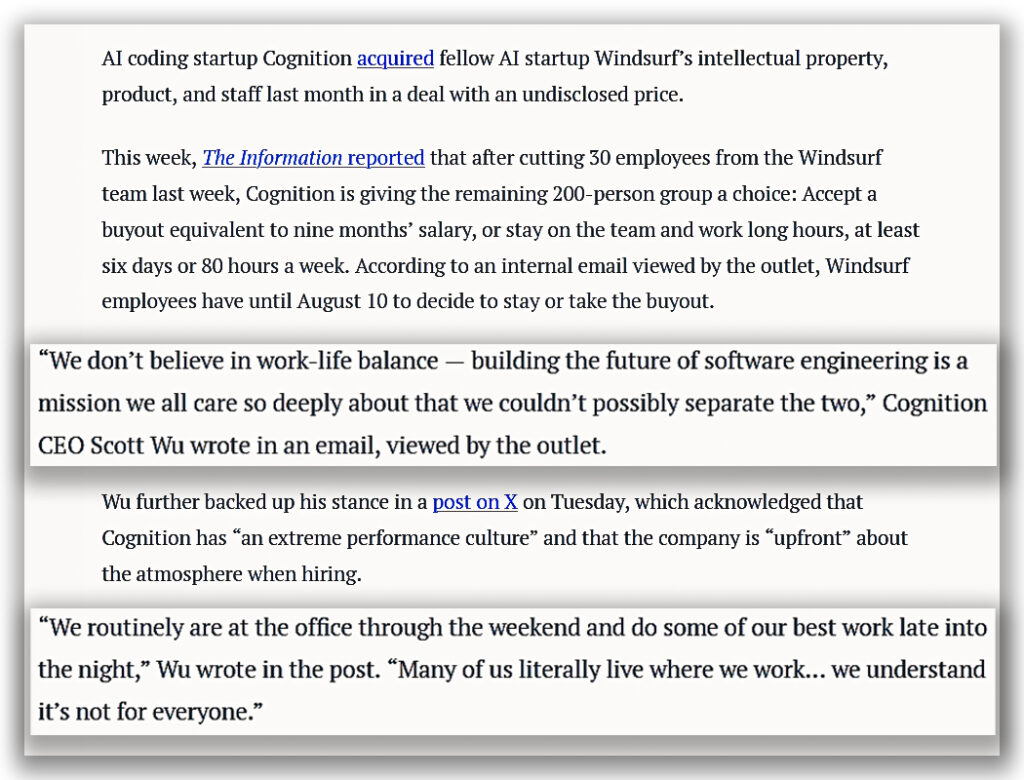
- Based in San Francisco, Cognition AI takes things a step further by providing living quarters at the office. The logic is simple: if employees never leave work, they can’t be late. Also, following its recent acquisition of AI coding startup Windsurf, the company reportedly gave employees a choice between committing to an intense schedule or accepting a buyout.
- Fella and Delilah, a telehealth company in Silicon Valley, offers better pay and equity to workers willing to commit to a 996 work schedule.
In addition to these companies, many early-stage startups funded by leading venture capital firms describe their environments as “high-intensity” or “not for everyone”, which is a thinly veiled way of signalling 70+ hour workweeks without saying it outright.
The wider adoption of the 996 work culture is also reflected in corporate spending data, which shows a surge in Saturday work-related activities in 2025, particularly in San Francisco. So, even though not every company is shouting about it online, their receipts tell a story: work is creeping further into the weekend. Slowly, quietly, persistently.
On paper, most of the deals offered by companies may sound great. In practice, however, it’s like offering someone a discount at a gym where the treadmills never stop.
Why Is the US Bringing Back the 996 Workweek?
There are several reasons companies give for embracing this model again, and some of them sound almost reasonable if you squint a little.
- The fear of falling behind China – As mentioned earlier, tech leaders worry that if American startups do not push hard enough, they’ll lose the AI race. But this argument might hold more weight if China hadn’t already abandoned the 996 work culture due to its long-term human cost. Copying the strategy without the context is a bit like trying to win a marathon by wearing someone else’s shoes, only to discover too late the shoes had been thrown away because they weren’t any good.
- Financial pressure – Startups often operate on thin margins. Their runway is short, their teams are small, and their ambitions are enormous. In such an environment, long hours become a survival tactic rather than a strategy. After all, the idea is simple: if humans cannot be duplicated, working them longer becomes the next best option.
- The myth of success through overtime – Some founders interpret China’s rise as proof that extreme work schedules were the secret ingredient. In reality, China’s economic success had far more to do with structural policies than forcing workers to skip dinner six nights in a row. But myths are powerful, and the tech culture apparently loves a myth it can turn into a lifestyle.
The Problem With the 996 Working Hour System? It Doesn’t Actually Work
Research consistently shows that productivity does not scale with hours. That’s because there is a limit to what humans can produce before stress, exhaustion, and the overwhelming desire to live a life ruin the whole plan. Here are some findings that put the 996 work schedule in a harsh light.
- High stress correlates with lower productivity – Studies consistently show that stress kills performance. When your brain is fried, your back aches, and even your cat seems to have forgotten who you are, doing your best work becomes impossible.
- The 4-day workweek trial proved the opposite of the 996 working hour system – Nearly 3,000 workers across 141 companies participated in the largest trial of shorter workweeks. The outcome was clear. Workers became healthier and happier, and productivity did not decrease. In fact, many companies saw performance improvements simply because their staff were not perpetually exhausted.
- China’s own experience shows the danger of 996 workweeks – More than three-quarters of urban workers in major Chinese cities used to suffer from chronic fatigue, sleep issues, pain, and stress. The toll had become so severe that legal intervention was necessary. This is not the kind of case study any country should be eager to repeat.
- Innovation suffers under extreme pressure – Creativity doesn’t thrive in environments where people are too tired to think straight. Great ideas come from relaxed minds. Breakthroughs happen when people have time to reflect. Yet 996 promotes a culture where the only acceptable thought is how to finish the next task.
- Burnout is becoming a silent epidemic – A 2025 Care.com report found that 69% of workers already feel at moderate or high risk of burnout.
When you look at the data, the conclusion is obvious: humans are not machines. And even machines would need maintenance.
Where Do We Go from Here?
Just a few years ago, the tech world prided itself on disrupting outdated systems, offering flexible hours, remote work, and beanbags scattered everywhere. Back then, the industry celebrated the idea of work-life balance. Now, ironically, the very people building AI solutions for a more efficient future are being asked to give up their evenings, weekends, and even dignity.
While AI is sold as a technology meant to help us work smarter and spend less time working, allowing for more balanced lives, it is, in fact, fast becoming a catalyst for reviving a work model so extreme it was ruled illegal in one of the most overworked countries in the world.
But the real problem is that the resurgence of the 996 workweek is more than a management choice. It’s a cultural signal. A sign that parts of the tech industry are clinging to outdated ideas of productivity while ignoring the mountains of evidence that contradict them.
It’s true that the 996 work culture cannot be legally enforced in the UK, the EU, and other countries where labour laws and cultural norms strongly protect work-life balance. But the influence still matters. When companies operating in democratic systems quietly push people towards brutal schedules, legality becomes a weak defence. In the 21st century, normalising a work schedule that borders on exploitation is not just unethical; it’s downright immoral, no matter how it’s packaged.
If we continue down this path, and more companies adopt this work schedule, we’ll not get more innovation. What we’ll get are more burnt-out teams, more failed ideas, and more people questioning whether the tech sector is worth the sacrifice.
At some point, we need to decide what progress actually means. Does it mean longer hours, less rest, and fewer boundaries? Or does it mean using technology to build a future where humans can work smarter, live better, and even enjoy their weekends again?
Personally, I vote for the weekend.
And if today’s tech companies want to build a better future, they need to start by not breaking the people who are building it.
Extra Sources and Further Reading
- Modelling the Significance of Work Culture on Burnout, Satisfaction, and Psychological Distress among the Gen-Z Workforce in an Emerging Country – Nature
https://www.nature.com/articles/s41599-023-02371-w
This peer‑reviewed research article examines how the 996 work culture and work overload are linked to burnout, psychological distress, and reduced well‑being among young workers, highlighting the human cost of extreme work cultures. - The Costs and Future of the “996” Work Culture: A Crossroads for China’s Workforce – Synergy: The Journal of Contemporary Asian Studies
https://utsynergyjournal.org/2024/12/22/the-costs-and-future-of-the-996-work-culture-a-crossroads-for-chinas-workforce/
This paper is a comprehensive academic overview of the health, social, and innovation costs associated with the 996 work schedule, and how prolonged overwork affects workers’ lives and long‑term productivity. - The Role of Work‑Life Balance in Effective Business Management – Cornell University
https://arxiv.org/abs/2510.05783?utm
This academic study demonstrates that work‑life balance initiatives significantly improve employee motivation, satisfaction, and organisational performance, underlining the performance benefits of balanced work schedules. - Why Working After Hours May Decrease Productivity – Human Capital Innovations
https://www.innovativehumancapital.com/article/why-working-after-hours-may-decrease-productivity
This paper shows how excessive work hours harm creative problem‑solving and overall productivity, supporting the argument that more hours do not equal better outcomes.