Key Takeaways
- Today’s AI governance frameworks are built on a hidden assumption: that AI decisions can be traced, explained, and audited.
- Quantum computing could break that assumption by creating AI systems whose reasoning is fundamentally untraceable, not just difficult to interpret.
- If that happens, current laws and safety tools won’t just be outdated — they may no longer apply to the systems they’re meant to govern.
- Governments are investing heavily in regulating classical AI, while largely ignoring the possibility that the underlying computing paradigm may soon change.
- There is still a window to prepare, but it may close quickly as quantum capabilities advance faster than expected.
- The key question isn’t whether quantum AI will arrive, but whether we are building governance systems that can survive when it does.
There’s a question that nobody in the AI safety community seems to be asking out loud, and the longer it stays unasked, the more costly the silence becomes.
It’s not about whether AI is conscious, or whether it will take our jobs, or even whether it might one day decide we’re more trouble than we’re worth. It’s a much more specific, and in some ways, more unsettling question: what happens to everything we’ve built to understand, govern, and align AI when the computers it was designed for no longer exist?
Because that’s where things seem to be heading, namely towards quantum computing becoming the foundation for AI. Maybe not next year, and probably not the year after, but at this point it’s no longer something we can dismiss as science fiction.
Quantum computing is moving from theory into real hardware faster than most governance efforts are moving from draft proposals into actual law. And when it does arrive at scale, it won’t just make AI faster or more powerful; it could also lead to a completely different kind of intelligence, one that “thinks” in ways we’ll no longer be able to trace or even make sense of.
So the real trillion-dollar question, which oddly doesn’t get treated like one, is whether the entire governance framework we rely on to make AI safe and accountable was built for the wrong kind of hardware.
Why does this matter? Because if quantum computing eventually leads to a fundamentally different kind of AI, today’s frameworks won’t just be outdated, but will also rely on assumptions that may no longer hold and target a form of AI that no longer reflects what we’re trying to govern.
When the Machine Stops Making Sense: The End of Traceable AI
To understand why building AI governance around classical computers without considering quantum computing might be a problem, it helps to look at what classical AI actually is at a fundamental level. Not in a technical sense, but in a more philosophical one.
Classical AI, like the systems that run ChatGPT, power credit scoring algorithms, or flag content on social media platforms, runs on silicon chips that process information step by step. One operation, then another, then another. The computation follows a path that is, at least in principle, traceable. That means, you can go back through a model’s weights, layers, and attention mechanisms, and reconstruct, at least approximately, why it generated a certain output. It’s hard, it’s expensive, and it’s often incomplete, but the possibility exists. This means the machine operates in a world of causes and effects that we can, in theory, follow.
That’s the foundational assumption on which the AI governance frameworks were built. The EU AI Act, with its emphasis on transparency and explainability for high-risk systems, assumes this. US executive orders on AI safety assume this. The whole field of AI alignment, which focuses on making sure AI systems act in line with human goals and intentions rather than just following the instructions we give them, assumes this too. Every interpretability tool, every mechanistic analysis, every red-teaming exercise is premised on the idea that the machine’s reasoning can be inspected, challenged, and corrected, which basically means it rests on that same foundation.
But that foundation doesn’t come from intelligence itself. It comes from the classical computers we’ve used to build and run these systems. And that assumption is so deeply embedded in the way we think about AI that it’s easy to overlook. We might say it’s the water we swim in. The problem is, quantum computing is about to drain the pool.
Here is why: quantum computers don’t compute in the same way classical computers do. This isn’t just about speed, like a sports car being faster than a sedan but still driving on the same road. It’s a difference in the very nature of computation.
Quantum systems rely on two properties that don’t really have a classical equivalent. The first one is superposition, which allows a quantum bit to exist in multiple states simultaneously instead of being locked into either zero or one. The second is entanglement, which creates correlations between qubits that persist regardless of physical distance and cannot be explained by any classical model of cause and effect. Because of this, when a quantum system processes information, it doesn’t follow a single path. It explores, in a very real physical sense, many paths at once.
Now, if you take that and apply it to machine learning, that’s where things start to get strange. When a quantum neural network learns from data, the learning process itself becomes difficult to track in the ways we’re used to. There’s a phenomenon that researchers have documented in peer-reviewed literature, published in Nature Communications, called “barren plateaus,” and it’s worth understanding what this actually means, because it’s not just a technical detail.
For a wide range of quantum neural network architectures, the gradient of the learning landscape, which is essentially the signal that tells the model how to adjust itself during training, fades away exponentially as the number of qubits increases. Once the model reaches a solution, the path it took to get there becomes, in a very precise mathematical sense, impossible to recover.
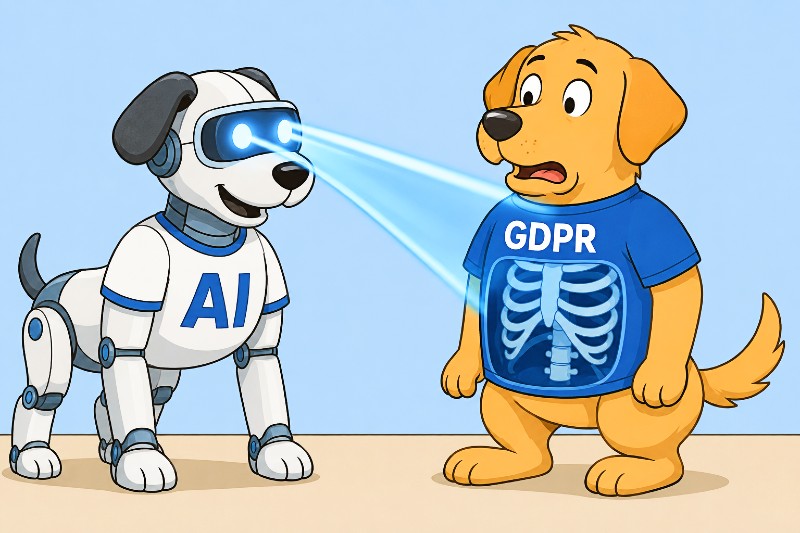
And that’s before we even get to the measurement problem. When you read the output of a quantum computation, the act of measurement collapses the quantum state, and in doing so, it removes access to the full information about how the system produced that answer. At the same time, entanglement inside quantum circuits makes it extremely difficult to isolate the contribution of individual components to a model’s predictions, in ways that don’t allow the kind of step-by-step tracing we rely on in classical systems. In practice, this means you get an answer, but you can’t trace the reasoning behind it.
That’s a problem because every tool we currently rely on to make AI trustworthy, every technique we use to ask “why did it give that answer?”, and every method we have for auditing a hiring algorithm, a medical diagnosis model, or a content moderation decision depends on the ability to trace the computation.
If quantum systems remove that ability, then we wouldn’t be dealing with an AI that’s just difficult to interpret. We’d be dealing with one that is, in practical terms, uninterpretable in the way we currently understand the word.
The Governance Collapse Nobody Is Talking About
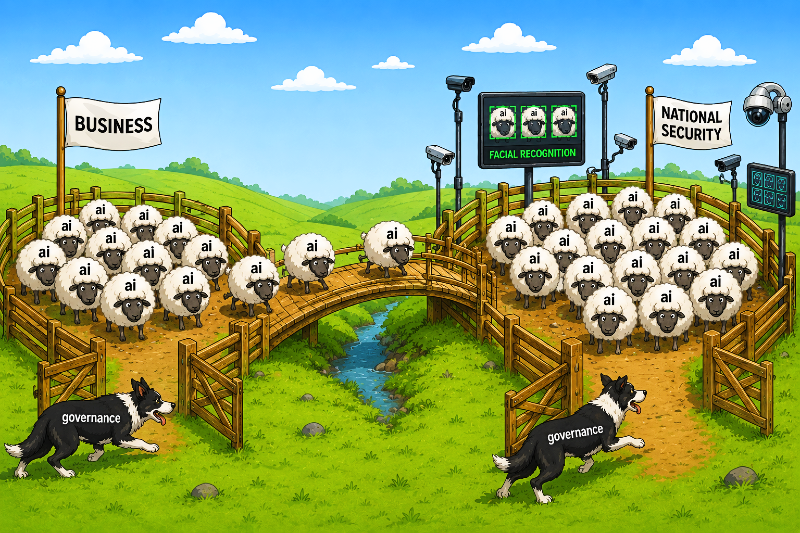
This is where things start to get unsettling, and where the irony becomes hard to ignore. Right now, governments around the world are pouring enormous resources into building frameworks to govern AI. The EU AI Act is already in force, the United States has issued executive orders and set up safety institutes, China has its own regulations. Thousands of experts are working on a problem that genuinely matters. And yet, almost all of that work is focused on AI running on classical computers, because that’s what exists right now, and we can only regulate what exists.
This leads to an uncomfortable implication: we’re spending billions and enormous political capital building governance structures for a type of AI that’s tied to a computing paradigm that may fundamentally change.
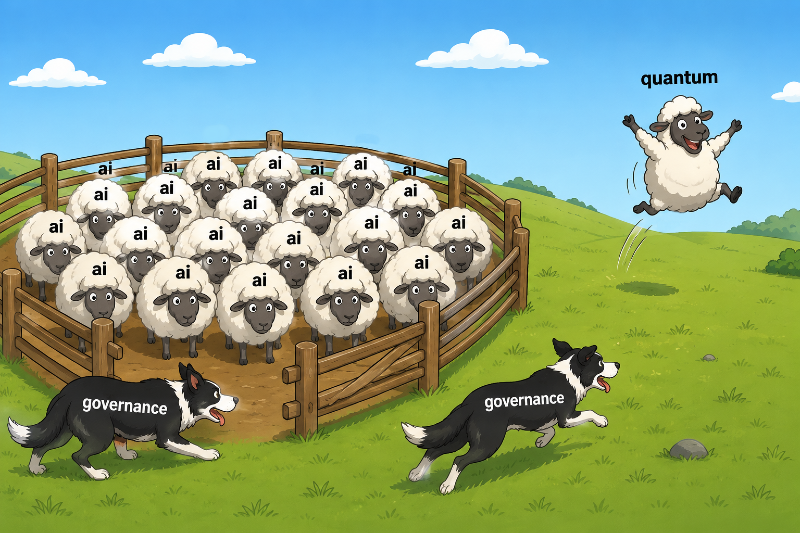
As quantum systems mature, AI won’t disappear, but it may evolve in ways that make today’s assumptions about how it works less likely to hold. That means the frameworks we’re building now could end up being mismatched to the systems they’re meant to govern in the future. It’s like spending twenty years developing traffic laws for horses and carriages, only for cars to arrive just as you finish. Except in this case, the “car” doesn’t just go faster, it moves through walls.
A January 2026 essay from Stanford Law makes this point clearly: current AI regulation emerged from concerns around fairness, transparency, and accountability. But quantum AI will likely introduce very different risks, such as cryptographic collapse, new forms of weapons, and systemic vulnerability. This suggests that frameworks like the EU AI Act may not just need updating in the future, but deeper rethinking in response to a completely different shift.
That doesn’t make today’s AI governance frameworks useless. They’ll matter for the classical AI systems that will continue to exist. But if policymakers treat them as finished solutions rather than as the first chapter of a much longer and more complex story, we risk entering the quantum era with the wrong set of tools.
That risk isn’t theoretical. It follows a pattern we’ve seen before. For example, we didn’t fully understand the impact of social media platforms until they had already reached billions of users. In much the same way, we didn’t think through the concentration of power in mobile ecosystems until a handful of companies were already dominating the space. So, when you look at it, we seem to have a habit of starting the governance conversation several years after the moment it would have actually mattered.
The Clock Is Running and Most Policymakers Don't Know It
The one piece of good news is that we’re not yet in the quantum AI era. Quantum computing in 2026 is still in what researchers call the NISQ era, where machines operate with hundreds to over a thousand qubits but are still highly error-prone and fragile. So far, no quantum system has shown a clear and undisputed advantage on a real-world problem.
Furthermore, IBM places meaningful large-scale, fault-tolerant capability somewhere around 2029. Google, Microsoft, and others are moving on similar timelines, but those timelines may already be behind reality, as recent progress in error correction is moving faster than many people expected just a few years ago, which means the time we have to prepare may be shorter than we thought.
This means the window to ask the serious governance questions, before the capability arrives, is open. But it won’t stay open for long. In fact, if we look at how transformative technologies tend to unfold, these windows usually close faster than anyone expects, often triggered by a single breakthrough that shifts the conversation almost overnight, much like ChatGPT did in late 2022 when it changed how the world talked about AI within weeks.
When that happens for quantum AI, the governments and institutions that have already been thinking about these questions in advance will be in a position to respond. The ones that haven’t will spend the next decade trying to catch up, writing regulations that are already outdated before they’re even signed into law.
Three Questions That Should Be Keeping Policymakers Up at Night
So what should actually change? Not in a vague “we need more research” kind of way, but concrete terms? Well, there are at least three questions that governance frameworks should be grappling with right now, and yet, for the most part, they aren’t.
The first is legal. If a quantum AI system can’t, by the laws of physics, explain its reasoning in any recoverable sense, can it legally make consequential decisions under existing law? The EU AI Act requires explainability for high-risk systems. But a quantum AI system making a medical diagnosis or a credit decision may be structurally incapable of providing that explanation, simply because the information may not exist in a recoverable form. And yet, almost no one in the current legislative conversation seems to be asking what happens in that case.
The second is disciplinary. Should quantum AI alignment be treated as a distinct research program, separate from the methods the field has developed around classical AI alignment? The case for yes is stronger than many people realise. The interpretability methods, the red-teaming approaches, the mechanistic analysis tools that the alignment community has spent years developing all assume that a system’s reasoning can be traced. But with quantum AI, that assumption may no longer hold. Not because the tools haven’t been updated, but because the underlying physics may make traceability impossible in principle. So this isn’t just a matter of adapting existing methods; it may mean starting from scratch, with different foundations, different threat models, and different success criteria. The sooner the alignment research community starts treating this as a foundational question rather than something to deal with later, the better positioned it will be when the hardware catches up to the theory.
The third is structural, and in some ways it’s an opportunity that looks like a problem at first. Classical AI runs on widely available hardware, which means that with enough money, almost anyone can access the compute. Quantum AI, at least for now, depends on highly specialised, expensive, and physically demanding systems that only a small number of organisations in the world can build and operate. This concentration is usually framed as a risk, and it is, but it also creates enforcement chokepoints that simply don’t exist in the classical AI world. Thus, if you want to control who gets access to advanced quantum AI capabilities, you can do it at the hardware level in a way that isn’t possible with GPUs. However, that opportunity won’t last forever. As the technology becomes more accessible, that leverage will fade. But right now, the chokepoint exists, and almost no policy conversation is treating it as the strategic asset it actually is.
A Decision That Affects Lives With No Explanation Available
So, have we been building intelligence inside the wrong machine? Not exactly. Classical AI has been, and will continue to be, one of the most important technologies we’ve ever created, and the machines behind it aren’t wrong. But the assumption that understanding it, governing it, and aligning it would prepare us for whatever comes next may turn out to be a costly mistake.
While the map we’ve drawn is detailed, thoughtful, and built with real effort, the territory is shifting in ways that may leave that map behind. And almost nobody in power seems to be asking whether the governance frameworks being finalised today will still apply to the systems we’ll be dealing with ten years from now.
This isn’t just theoretical. At some point in the next decade or so, an AI system run by a bank, an insurer, a hospital, or an employer may make a decision about you. These systems already exist, and they’re already difficult enough to understand. But today, at least in theory, you can ask why. You can challenge the outcome. You can push back.
With quantum AI systems, on the other hand, that may no longer be true. Not because companies will refuse to explain, and not because regulators will fail to act, but because the explanation may no longer exist in any meaningful sense. You could be left with a decision that affects your life, and no way to understand how it was made and what can be done about it.
This isn’t a science fiction scenario. It’s where the technology is heading, and the gap between what these systems can do and what our laws are built to handle is already widening quietly and faster than many realise. Because the decisions that are being made now will shape the kind of recourse we have when a system we never chose makes a decision that affects our lives, we deserve to be part of the conversation. But right now, you’re not even being told it’s happening.
Add Your Heading Text Here
- What Is NISQ Quantum Computing – The Quantum Insider
https://thequantuminsider.com/2023/03/13/what-is-nisq-quantum-computing/
This article provides a brief overview of the NISQ era, describing today’s quantum computers as powerful but still noisy and unreliable systems that sit between early prototypes and fully scalable quantum machines. - What Is Quantum Computing – IBM
https://www.ibm.com/think/topics/quantum-computing
This article explains the fundamentals of quantum computing, including key concepts like superposition, entanglement, and interference, and how these properties allow quantum systems to process information in ways that go beyond classical computation. - Intro to Optimization in Deep Learning: Gradient Descent – Digital Ocean
https://www.digitalocean.com/community/tutorials/intro-to-optimization-in-deep-learning-gradient-descent
For readers unfamiliar with gradients and how they’re used in training, this article introduces gradient descent, a core optimisation method in deep learning, and explains how models are trained by iteratively adjusting parameters to minimise error. - Computing the Gradients With Respect to All Parameters of a Quantum Neural Network Using a Single Circuit – Cornell University
https://arxiv.org/html/2307.08167v4
This paper explains a more efficient method for training quantum neural networks, where gradients for all parameters are computed using a single quantum circuit, reducing the computational cost and limitations of current approaches on real hardware.